The Long Way Over the River Bridge
A big steel truss carries a sidewalk that most drivers never notice. Nell climbs the hidden stairs, leans into the July wind, and stops at the exact middle of the span.
Every day a few thousand drivers cross the big river bridge without once touching it. A sidewalk runs the whole span on its downstream side, and almost nobody seems to know it exists. I crossed it on foot in the second week of July, and I have been recommending it since.
The bridge carries a state road over a wide tidal river, between two towns that trade glances across the water. I am leaving the name off on purpose, because the experience belongs to a whole family of bridges. If a big span near you carries a walkway, most of this essay will translate directly.
Everything you truly need to know in advance fits comfortably in one line. The crossing runs about a mile, the wind is real, and the middle changes how you think about rivers.
Finding the stairs
The hardest part of walking a road bridge is locating the polite way onto it. On the west bank the sidewalk begins at a stair tower tucked behind a boat supply yard. There is no banner and no arrow, only a painted rail and a city notice about keeping the gate clear. I walked past the entrance twice, which I now consider part of the tradition.
The stairs climb in five short flights, turning at landings that each frame a wider slice of river. You rise past a rooftop garden, a billboard's bare skeleton, and finally the first green shoulder of steel. The last landing delivers you onto the walkway, a concrete ribbon about four feet wide. A rail stands between you and the water, chest high and reassuringly overbuilt.
Cyclists use the same ribbon, so keep right and let the bells pass on your left. The morning I crossed, I met exactly one bike, one runner, and one man carrying a fishing rod. All three said good morning, which tells you how rare company is up there.
Under the truss
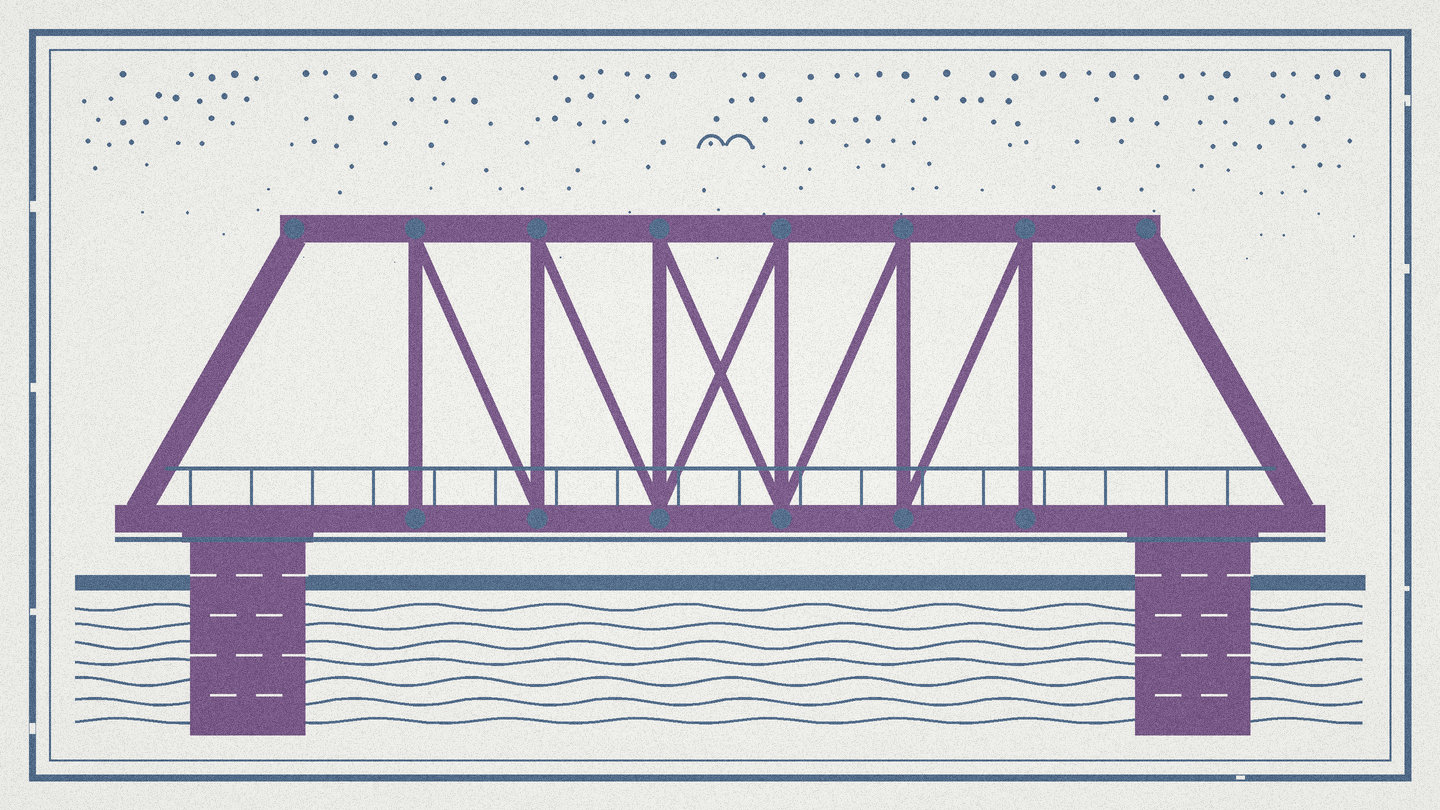
The truss begins a few hundred feet out, and walking into it feels like entering a long green hall of crossed steel. Its members pass overhead in a rhythm you can count, four strides to a panel, all the way over. Rivets the size of plums stud every joint, each painted so many times it has soft edges. Look up long enough and the geometry starts to feel less like engineering and more like weather.
The bridge is loud, though the loudness arrives in an organized and almost musical way. Every passing truck sends a low chord through the steel, and the railing carries it to your hand. Between trucks you hear gulls, halyards from the marina below, and wind combing through the members. I stopped once to listen with my palm flat on a diagonal, feeling traffic four lanes away.
Painters had left small numbered tags on the panels, bookkeeping for a job that plainly never ends. Maintaining a span like this is a patient trade, handed down the way lighthouse keeping once was. It comforted me to walk through the middle of somebody's careful, endless work.
The middle of the span
You know the exact middle without a sign, because the deck stops climbing and the wind takes over. In July the wind came up the river in long steady shoulders, warm but insistent, smelling of salt. It flattened my sleeve, stole a receipt from my pocket, and argued for a hat with a chin strap. Hold the rail, plant your feet, and give the moment the full minute it has earned.
The view from the middle organizes itself neatly into three long panels. Upstream the river narrows past mooring fields toward hills that look painted on. Downstream it widens toward the sound, silver and businesslike, streaked by one slow barge. Straight below, a hundred feet down, the current drew long seams in the water like pulled fabric.
The middle of a span is a genuine place, though no map bothers to mark it. You stand equally far from both banks, briefly a citizen of neither town. I find that five quiet minutes there can reset an entire ordinary week. Then the wind makes your eyes water, and the far tower says come along.
Bridge manners
A walkway this narrow runs on small courtesies, and they are easy to learn. Step into a panel bay when a bike bell approaches, since the bays give a foot of extra room. Keep the phone pocketed while walking, because the rail is high but attention is still the main equipment. Photographs come out better from the bays anyway, framed by steel instead of blur.
Do not drop anything over the rail, and I do mean anything at all. The river below carries kayaks, moorings, and patient fishermen, none of whom ordered a bottle cap from the sky. Litter aside, the wind will audit your grip on hats, maps, and loose sleeves. Zip the jacket, cinch the strap, and the bridge will have nothing on you.
If a maintenance crew has coned off a stretch, give them the full lane and a nod. The crossing exists because somebody paints, patches, and inspects it on a schedule nobody applauds. A friendly wave from a walker is small rent for a mile of sidewalk in the sky.
Down the far side
The east half of the crossing goes faster, the way the second half of anything does. The deck slopes gently down, the panels count themselves off, and the far town rises to meet you. The ramp lands beside a small park with two benches and a drinking fountain that works on the third push. I sat for ten minutes and watched the bridge from below, already missing the wind a little.
The far bank offers a counter with iced coffee, a seawall to drink it on, and an hourly bus back across. Walking back over is the better return, in my opinion, because the light will have changed. I crossed again at half past five, and the river had turned from pewter to brass. The steel was the same and the mile was the same, yet the bridge felt entirely new.
Worth the walk
A big bridge crossing is a plain wonder, and it is not for every walker. If open height sits badly with you, trust that feeling and enjoy this span from the seawall instead. The walkway runs narrow for passing strollers, the stairs rule out wheels on the west end, and shade does not exist. Wind gusts hardest at midspan, so leash your hat and skip the crossing on stormy days.
Bring water, wear shoes you trust, and check the sidewalk status before you go, since repairs close it now and then. Give the full mile an unrushed hour, including your minute in the middle. Rivers look different once you have stood over the center of one, and the difference stays with you.
Mile notes
- Sidewalk status and repair closures are posted on the state transportation department's bridge pages.
- Tide and wind conditions come from the public marine forecast for the river mouth.
- Hours for the small park and seawall on the east bank sit on that town's municipal pages.

Nell Harrow, founder and editor. Walks out of Providence, writes on the way back.
Connecting routes
- JunctionsThe Last Train Back
- JunctionsA Slow Walk Along the Airfield Fence
- CircuitsOut to the Harbor Light and Home Again