One Hour at the Ferry Landing
Sixty minutes at a working ferry landing in March: iron bollards, gulls on their poles, a boarding line of cars and crates, and the horn that ends it.
The hour is the honest unit of a ferry landing, and March is the landing's honest month. I went to the state pier at Point Judith to spend exactly one of those hours, ten forty to eleven forty. The boat to the island sails all year, and I had no intention of being on it.
This is a junction essay, which means the walking stays in one place while everything else moves. A landing rewards that posture better than almost any public room I know. Around you everything is in motion, or about to be, or just finished, and you are the fixed point taking minutes.
Dress for wind off forty degree water, because the pier offers no shelter worth the noun. I carried a wool hat, a thermos of tea, and a pocket notebook that the wind kept auditioning. All three of them proved their worth well before the boat ever showed.
The landing at ten forty
This port is a fishing harbor first and a ferry landing second, and your nose learns that before your eyes do. Diesel, salt, and the sweet low note of the fish houses arrive braided into one working smell. Trawlers lay along the bulkhead with their booms crossed, resting between arguments with the sea.
The ferry berth itself was empty when I arrived, which is the right way to begin. An empty berth is a stage with the set fully dressed, ramp raised, lanes striped, signs patient. Cars were already queued in lane one with their engines off, and a dog steamed up one rear window.
Past the lanes, the harbor of refuge opens behind its long breakwater, a gray room with one door. Everything entering or leaving the port lines up on that door, which gives the water a paced, theatrical order. I checked my watch against the terminal clock and found them agreeing on ten forty two.
I found my post at the rail near the pilings, out of the forklifts' way and inside the gulls' theater. A landing assigns you a role if you stand still long enough, and mine was evidently recording clerk. The tea helped the role along, poured into the cap one measured inch at a time.
The pilings keep the tide's diary in rings of weed and barnacle, and the morning read about half full. A workboat crossed the channel with a load of traps, and its wake slapped at the ledger for a minute. I wrote that down as well, since the hour was long and the notebook was patient.
Bollards and lines
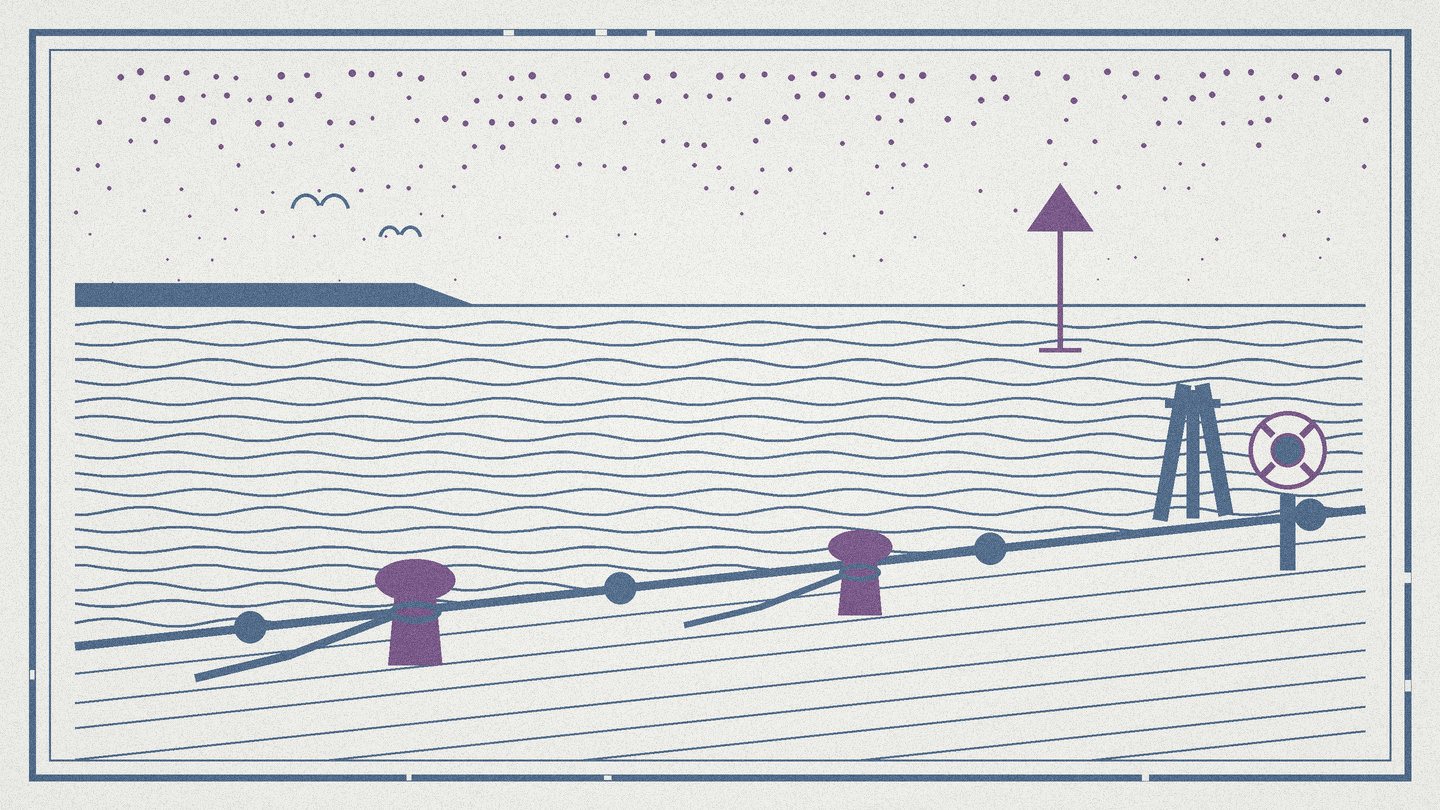
The bollards are the furniture I came for, and this landing keeps a serious set of them. They are iron, squat, and swollen at the crown, painted so many times the paint has geology. The one nearest the ramp wears a groove burnished smooth, the signature of ten thousand tie ups.
A bollard does exactly one thing, and the doing stays invisible until a boat arrives. Then a deckhand drops a looped hawser over the crown, takes a turn, and several hundred tons of steel agree to stay. I find that agreement more persuasive than most of the speeches I have heard.
While the berth waited, a man in orange oilskins hosed the apron, herding fish water toward a drain. He worked around me without comment, the way a mower works around a lawn chair. Watchers are part of a landing's standing furniture, and the port has decided we are harmless.
The gulls' shift
Gulls run the landing's second shift, and in March they run it hungry. The big herring gulls hold the light poles, one gull to a pole, like a filing system with wings. The younger birds patrol the apron for spills, walking with that fast offended stride they never outgrow.
A dock cart of totes crossed from the fish house at eleven sharp, and the poles emptied in one motion. The birds came away with nothing and returned to station without any visible embarrassment. Gulls hold no grudges about outcomes, only about position, and the poles were soon fully staffed again.
When the boat showed past the breakwater at eleven oh five, every gull adjusted by exactly one pole. They read the schedule better than the printed board does, and they hold no opinions about weather. The horn sounded once, short and businesslike, and the whole pier came up half a note.
The boat comes in
Docking is a slow conversation between rudder, wind, and fender, and it finishes in about four minutes. The bow swung wide, the props stirred a lane of jade colored water, and the hull settled against the pilings. Two hawsers went over two bollards, and the ramp came down with a clang you feel in your teeth.
Off came a mail van, two pickups, a gravel truck, and eleven walkers carrying the mixed luggage of island errands. I logged milk crates, a rolled rug, a boxed television, and a cat carrier with a face in it. The landing absorbed the whole delivery in about ninety seconds and turned itself around like a page.
In the lull that followed, a deckhand walked the rail and checked each line with the toe of his boot. Another wiped down the ramp chains and said something that made the loader laugh into his radio. Work you cannot hear is still work, and from thirty feet away it looks like choreography.
Boarding and the horn
Boarding ran with the calm of a thing done ten thousand times before lunch. Lane one woke its engines, the loader waved cars up the ramp with two fingers, and the walkers filed after. A deckhand steadied an older traveler's cart at the ramp lip without spending a word on it.
What people carry to an island in March is a fair census of island life. My notebook lists groceries, lumber offcuts, a chainsaw case, three backpacks, and one guitar arguing with the wind. The gulls audited the groceries from their poles and filed no objection.
At eleven thirty the ramp rose, the hawsers slipped the bollards, and open water appeared between hull and fenders. The gap measured one foot, then ten feet, then the width of the whole harbor. One more horn, one folding wake, and the berth went back to being a dressed stage.
Worth the walk
An hour at the landing suits watchers, list keepers, and anyone rebuilding their patience in a public place. The aprons are flat, step free, and workable with a stroller, but the wind writes half the story in March. Seating is scarce and the pier keeps no indoor corner, so plan on standing your hour.
Board nothing, and let the boat leave without you, because that is the entire discipline of the visit. The horn makes the ending easy, and the empty berth makes it clean. My bus back into the city met me at eleven fifty, exactly on its printed word.
Mile notes
- Sailing times confirmed on the printed schedule board posted at the landing
- Port background drawn from the state's public pier information pages
- Bus connection times from the posted schedule at the park and ride lot

Nell Harrow, founder and editor. Walks out of Providence, writes on the way back.
Connecting routes
- JunctionsThe Long Way Over the River Bridge
- JunctionsThe Last Train Back
- CircuitsOut to the Harbor Light and Home Again